|
2011-12-15

As consumers brave the cold and the seething, pepper spray-happy crowds for holiday shopping this year, they’ll have more options than ever for clothing that claims to be “eco-friendly,” both in boutiques and in major chains.
Fabric from bamboo is being touted as an environmentally friendly alternative to typically-pesticide-heavy cotton clothing. No disputing that it’s soft, colorfast and grows like a weed. Or when you buy bamboo fabric are you just getting, um, bamboozled?
On the big end, H&M launched a Conscious Collection for fall for the second year, and is teaming with Greenpeace’s “Detox” campaign to work to “reduce the use and impact of hazardous chemicals.” Puma committed to eliminating all emissions in its supply chain by 2020, as did Nike. Nike also plans to publicize how it did so in hopes of fostering a spirit of collaboration across the industry.
The smaller end, Los Angeles-based designer Sarah Nami Ahn told me, “Almost every apparel company is going toward this direction to make a mark for themselves. It’s almost standard.”
Ahn is the sole full-time employee of her company, NAMI, the bio for which takes time to note the start-up’s commitment to “sustainable practices and using green materials.” The rhetoric may sound similar, but never identical. There isn’t a hard and fast definition of ecofashion, although it’s some combination of organic raw, or recycled materials—anything from old clothing to plastic bottles—processed without undue harmful chemicals, and made with fair worker practices. Usually you can find a company that boasts one or two of these things, but clothing that meets all of these qualifications is pretty rare.
And at this point, it would probably be prohibitively expensive. Companies trying to cover as many of their bases as possible can also end up putting things on their website like Portland-based Nau did, which admits to high prices and attempt to explain delicately why an organic-cotton flannel shirt costs $130.
Ahn makes no claims for the fabrics being sustainable or organic, not yet. “I do go to China to make my final samples and have them manufactured there,” she said. Her first steps to being a sustainable business are using as much recycled paper in her design as possible, and researching bamboo-based fabric from Nepal. Ideally she’ll start by sponsoring the planting of the very renewable resource of bamboo, to offset the costs of traveling back and forth. Then she’ll start importing her bamboo-based fabric, produced in Nepal.

For environmentalists—or bamboo investors who acknowledge that pandas probably aren’t long for this world—the growing interest in bamboo fabric must sound like good news. Bamboo grows quickly—up to three feet a day—because it’s a grass, rather than a tree. It absorbs carbon dioxide and pumps out oxygen efficiently and can be grown in really poor countries, like Nepal and Vietnam. The local economic benefit of bamboo is so strong that Rwanda’s Minister of Forestry and Mines urged farmers to get started planting it right away, for timber as well as fabric. And the fabric produced is softer than even organic cotton or linen. Bamboo-baby.com claims it is even softer than cashmere and boasts a Global Organic Textile Standard (GOTS) certification for its clothing—rather dubiously, as I found out.
According to Marcus Bruegel, technical director for the International Working Group at GOTS, bamboo-based fabric could not “in principle” become certified to GOTS, “even if the bamboo plant was originally certified organic on the field.”
Bruegel explained in an email that the industrial process of melting the fibers down with sodium hydroxide and regenerating them as a cellulose-based viscose means the resulting fabric has to be called rayon. The manufacturing process—rather than the material comprising—defines rayon, which can be made from almost any type of plant or tree. Its colorfast properties made it popular in the 50s and 60s for making history’s most notorious Hawaiian shirts, and subsequently its popularity typically spikes in tandem with the price of cotton. Bamboo fibers can only be used up to 5 percent for the label grade “organic” and up to 10 percent for the label grade “made with organic materials,” unless it is socks, leggings or sportswear, where it can be up to 25 percent (presumably due the practical restraints of elastics).
Both the FTC in America, and the Canadian Competition Bureau slapped some wrists in 2009, when companies were found labeling their clothing as just “bamboo” rather than rayon, as labeling laws on both sides of the border—and in the EU—require. The FTC had also charged the companies for claiming that their products were made with environmentally-friendly manufacturing processes, which the FTC argued is false since rayon manufacturing “uses harsh chemicals and emits air pollutants.”
To make rayon, the plant materials are cooked in lye—sodium hydroxide—and then treated with carbon disulfide.
European manufacturers Lenzing AG of Austria makes a particular type of rayon called lyocell that is made with a “closed-loop system.” As the name implies, this means that 98 percent of the solvent—an organic compound N-Methylmorpholine-N-oxide —is caught and reused. The Swiss company Litrax AG has been working with Lenzing to manufacture bamboo-based cloth using these same principles.
The final product is more expensive than viscose bamboo, and Litrax’s founder, Felix Stutz, said that he sees his product as more of a specialty than everyday fabric. “I doubt that this will compete with cotton, and it will probably cover at most 5 percent of the industry, but it will be a very pleasant contribution and will add a bit of sustainability in terms of material resources,” Stutz told Textile World.
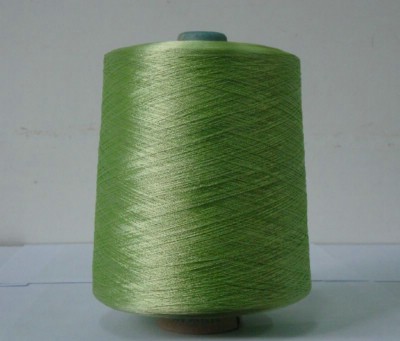
Here’s a spool of rayon embroidery thread
Conspicuously, bamboo doesn’t exactly flourish in the Alps, which means either the raw materials will have to be moved to Europe, or manufacturing moved to China. This puts a continental divide between those doing the manufacturing and those who are to ensure its ecological responsibility, and a price difference that encourages conflation, double-speak and little transparency by suppliers.
While several Chinese companies claim to have patents on textile manufacturing from bamboo, eco-blogger Michael Lackman traced the patent back to Hebei Jigao Chemical Fiber Co., Ltd. In spite of a pretty dubious name, Jigao Chemical Fiber has a Oeko-Tex certification that their end product is chemical free. This doesn’t reflect how much energy was used or waste produced in the process though, to say nothing of the chemicals used and where they ended up.
I asked Ahn where all of this puts eco-friendly fashion, if such a thing can exist, and she remained steadfast that it can exist and is on the way. “In fashion we always talk about the zeitgeist,” she said. “It’s kind of a way of culturally marking, historically through costume or through this apparel.” Right now fashion is moving towards a consciousness of what we consume—what it’s made of, and how it’s produced in addition to how it looks – if not a serious change in production itself.
If fashion does mark certain cultural moments, it can also reveal some uncomfortable truths about the interplay of public relations, trendy consumer concerns and our short attention spans. H&M is a prime example; in 2002 the company vowed to ban PVC from its products, in response to a then-very-hot campaign. As trends and public concerns shifted, PVC was quietly reintroduced, only to be once again declared out of bounds by their new agreement with Greenpeace. Sustainable fashion is one measure of (one part of) society’s commitment to sustainability. Whether that is a passing trend or a growing cultural value remains to be seen. At this point fashion indicates that the zeitgeist has shifted toward at least lip service.
Any lapsed vegetarian can probably relate to the difficulties of resolving upstanding ecological ideals with the mundane realities of modern life. It’s an imperfect world, and Ahn is the only full-time employee at a business she’s still paying for out of pocket. Certain realities of the clothing industry limit what NAMI can do in the short term. “We can’t all be able to eliminate the carbon footprint and have a sustainable product if it’s not possible [to] then also make the product affordable,” she said. “We just have to do the best we can.”
Both consumers and manufacturers are now in the position where they have to prioritize: Do you aspire to have organic raw materials, at the expense of the manufacturing process? Do you aspire for both, but still import those raw materials? Is there any amount of money you can pay to get clothing locally?
Of course, you can always skip the whole new-clothing ethical debate and go to Goodwill. Merry Christmas, Mom.
Source:motherboard
|





 浙公網安33010602010414